“Navali se Shar planina”
(“Навали се Шар-планина”)
Serbian Traditional Folk Song
– – – – – – –
Disclaimer:
This is a long read with a few digressions, so just take a deep breath, relax and get ready for a deep dive into some unknown territories! It is a long and winding road, leading eventually to its final destination. I guarantee you won’t be left indifferent after reading it and you’ll also learn something new and interesting along the way. Anyway, there are plenty of nice pictures and photos too! 🙂
As an ultimate reward – if you manage to read this entire article – rest assured that your natural human ability to focus your attention for a prolonged periods of time is not yet destroyed by the SNSA pandemic – aka Social Networks Scrolling Addiction (coined by yours truly 😀 )
If you would still prefer to take just a quick literary stroll – I’d definitely recommend my previous essay for the folk song Quiet Fog (Tija Maglo) – link here.
Cheers!
– – – – – – –
I
THE WIDER GEOGRAPHIC LOCATION AND HISTORIC CONTEXT
“Navali se Shar-planina” (Навали се Шар планина) is an old traditional shepherd song. Its name indicates obviously that the narrative unfolds around the Shara Mountain (Шар-планина / Планина Шара) which is located in central part of the Helm region of Southeast Europe.
The Helm region is the main land mass of Southeast Europe. Despite its ancient original name, the Helm region is in present times referred to as the Balkan peninsula.
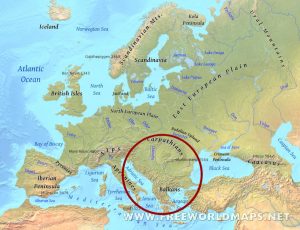 The geographic location of the Helm / Balkan region within Europe. This region includes the territories (full or partial) of the following countries: Albania, Bosnia and Herzegovina, Bulgaria, Croatia, Greece, Hungary, Moldova, Montenegro, North Macedonia, Romania, Serbia, Slovenia, Turkey.
The origin of its modern name – Balkan, is obscure and, according to etymologists, it supposedly stems from either the Ottoman Turkish or the Persian language. Interestingly, this land mass has never been a historic native living space of these two ethnic groups. Although their empires kept parts of the Helm region occupied for some time, their traditional ethnic lands are located in Asia. Nonetheless, this foreign name has been consistently pushed into the mainstream by modern Western European powers in an effort to obscure its traditional, historic name – Helm. Still in use today by the local population, it had been given to their own lands by the Thracian people whose culture emerged there during the Bronze Age and flourished in the 3rd and 2nd millennium BC. Even the ancient Greeks incorporated it to their language as Haemus.
The Helm land is not a peninsula at all, but rather an integral land mass of Southeast Europe. This fact is obvious even after a brief look at the geographic map of Europe. While modern geographers acknowledge this fact and are actively challenging the concept of a Balkan peninsula, this term is being continuously imposed for the geopolitical goals of the Western elites. Balkan peninsula, as a term and concept was created by the German geographer August Zeune, as recently as in 1808.
II
ICONIC MOUNTAIN RANGES OF THE HELM LANDS
The Helm region is predominantly a mountainous, hilly geographic region interspersed with large mountain ranges, high plains and some lowland valleys. In addition to many mountains with breathtaking landscapes it features some of the most beautiful coastlines in the world. Helm sits at the northeastern edge of the Mediterranean basin and is surrounded by five large bodies of water: Adriatic Sea, Ionian Sea, Aegean Sea, Sea of Marmara, and Black Sea.
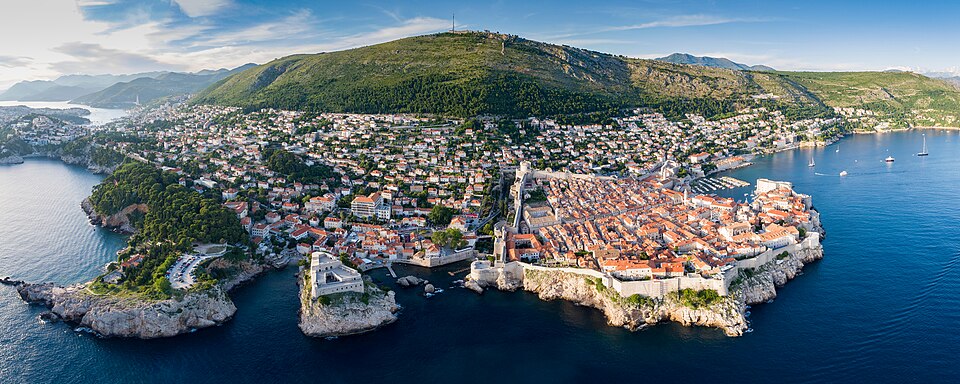 Panoramic view of the ancient city of Dubrovnik on the coast of the Adriatic Sea
The largest mountain ranges in the Helm region include:
– Dinaric Alps (aka Dinarides), run along the Adriatic Sea and are one of the most rugged and extensive mountainous areas of Europe. The Dinarides are named after Mount Dinara, a prominent peak in the center of the range. The people of the Dinaric Alps are on record as being the tallest in the world, with an average male adolescent height of 185.6 cm (6 ft 1 in).
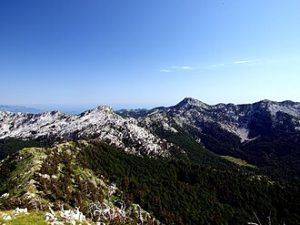 Orjen spreads between Bosnia and Herzegovina and Montenegro and is the most heavily karstified range of the Dinarides.
– Rhodope Mountains form part of the Rila-Phodope massif, which is the oldest landmass in the Helm region. Their name is of Thracian origin, which the ancient Greeks incorporated into their mythology. According to the myth, the King Haemus of Thrace and his wife, the Queen Rhodope, offended the gods and were transformed into the mountains Haemus and Rhodope as a punishment by Zeus and Hera.
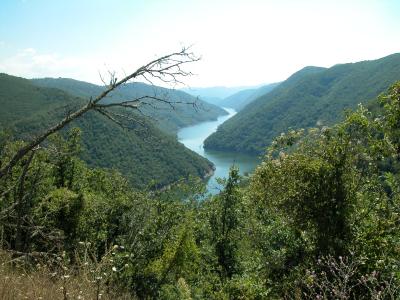 The river Mesta crossing the Rhodope mountains
– Balkan Mountain Range is the source of the modern name of the Helm region – Balkan. In Bulgaria and Serbia they are also known as Стара планина (Stara planina), literally meaning The Old Mountain. In the Antiquity these mountains were known as Haemus, derived from its original Thracian name.
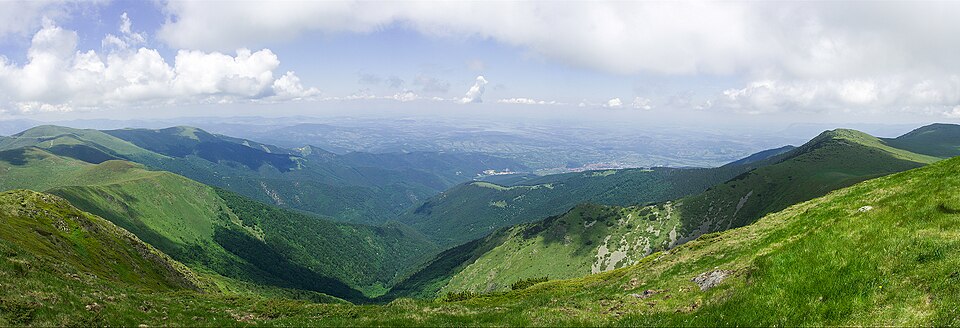 A view of the Balkan Mountains from the Kom Peak in western Bulgaria
– Carpathian Mountains – the largest mountain range in Central and Southeast Europe. They can be considered The True Slavic Mountains as they are encompassed entirely within the historic Slavic lands.
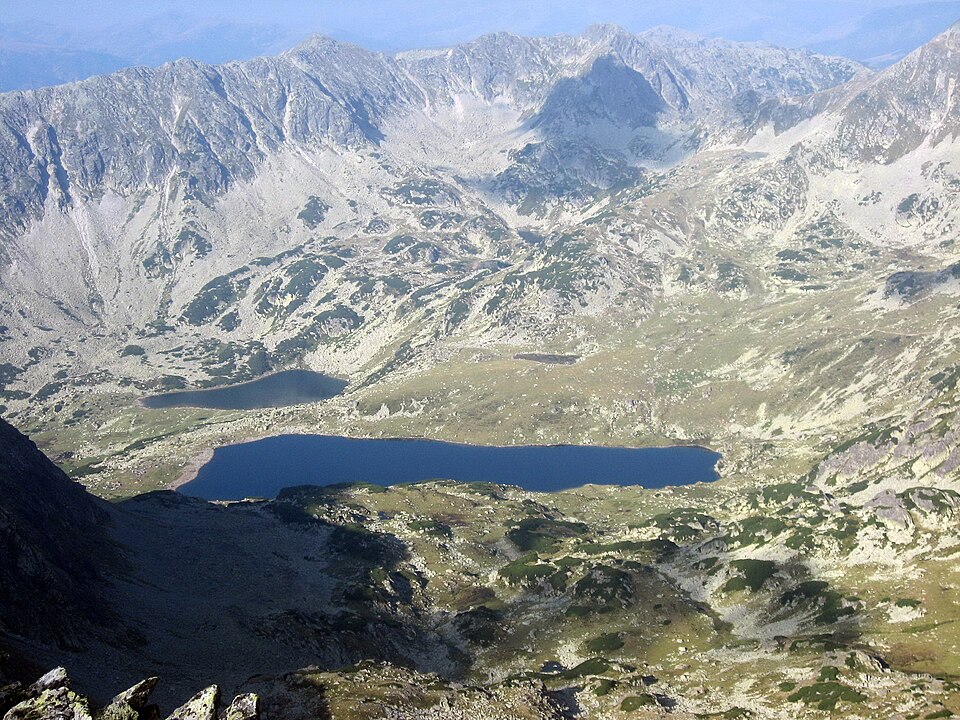 Lake Bucura, Southern Carpathians, Romania
The Carpathian Mountains also host the cradle of the European civilization which is located in the Lepenski Vir archaeological site in Serbia, dated as far back as 9500 BC. This Mesolithic site is the oldest human settlement in Europe and it lies on the right bank of the Danube river where the Iron Gates Gorge cuts through the southernmost section of the Carpathian Mountains.
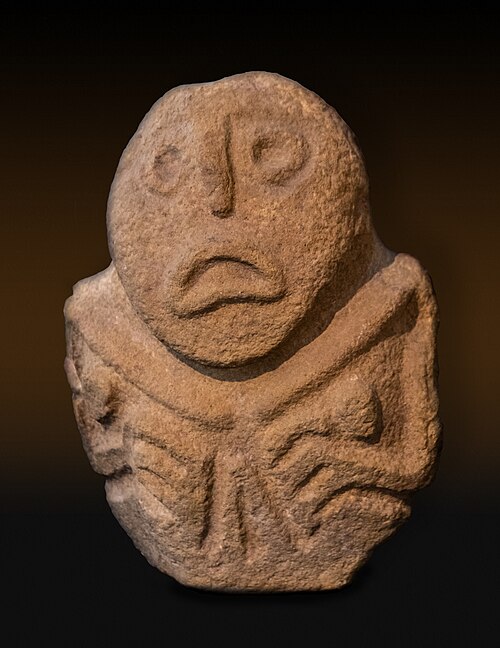 Sculpture from the Lepenski Vir culture – the famous “Foremother” cca 7000 BCE
This list is just a tip of the iceberg as there are many more magnificent mountains in the land of Helm. I have to highlight a couple of the lesser known, but not an inch less magnificent, mountains that are displaying some unique properties:
– Rtanj Mountain in eastern Serbia:
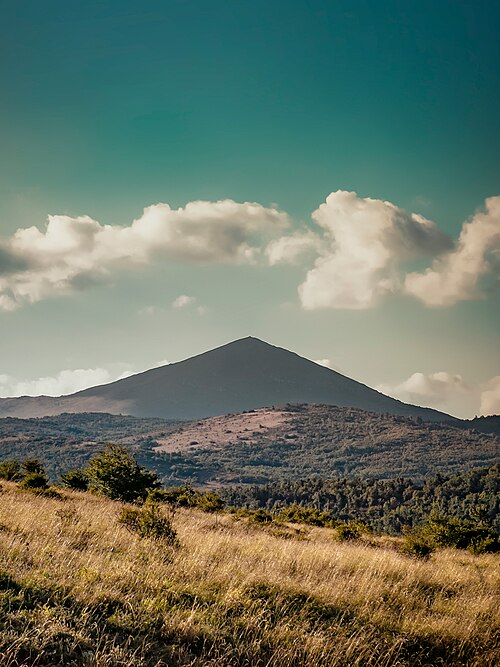 https://en.wikipedia.org/wiki/File:Rtanj-mountain.jpg
The Rtanj Mountain is also known as the “Serbian Pyramid” as it features a nearly perfect tetrahedron – a triangular pyramidal shape. Mountain Rtanj (Serbian: Ртањ – pronounced [r̩̂ːtaɲ]) is a part of Southern Carpathian mountain range and is well known for its unique properties including strong positive energy field surrounding it as well as many endemic medicinal herbs growing on its slopes. It also exhibits some inexplicable characteristics such as that some of its geometric properties are matching those of the Pyramid of the Moon in Mexico and the Great Pyramid of Giza in Egypt. It is also shrouded in mystery because of the numerous sightings of unidentified flying objects and lights hovering around its highest peak.
– Bosnian Pyramids in Visoko – another example for a mountain of an unknown or at least debated origin (human shaped vs. naturally formed) exhibiting some peculiar geometric and electromagnetic properties and featuring a complex network of tunnels:
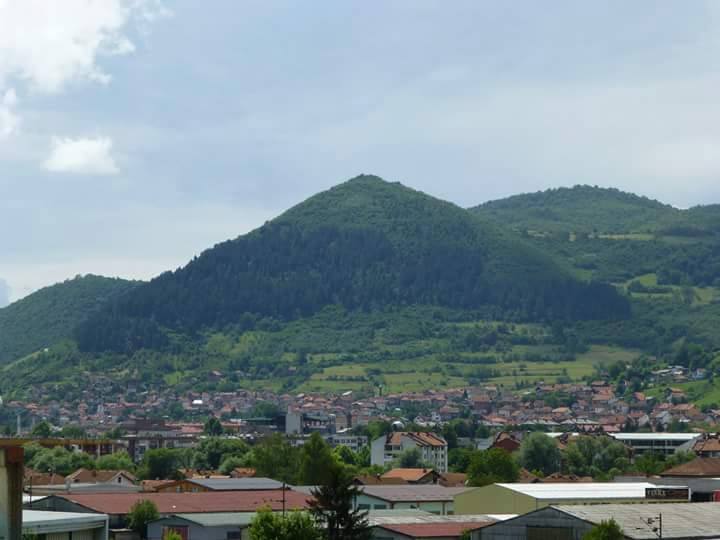 https://en.wikipedia.org/wiki/File:Bosnian_Sun_Pyramid_Lookout.jpg
see also:
Archaeological park: Bosnian Pyramid of the Sun Foundation:
https://piramidasunca.ba/en/pyramid/
After all these examples it is obvious that, regardless of their geologic types, shapes and physical features, mountains are undoubtedly magnificent objects that bring awe to the human eye.
Mountains’ energies at their foothills and peaks are affecting humans in very different, rather contrasting ways. Looking up at a mighty giant from its foothills, one realizes its magnificence and immense power and becomes overwhelmed with a sense of insignificance and humbleness. In contrast, when the mountain is finally conquered and a stunning panoramic view of the horizon unfolds – a sense of fullness, lightness and peace arises. There, at the summit, one experiences an exhilarating state of bliss, gratefulness and a kind of spiritual realization.
Such is the magic of mountains – places where mythical beings and spiritual entities dwell. Perhaps their greatness, powerful appearance and enormous efforts required to conquer their rugged terrains and unpredictable weather conditions are the very reasons for all the supernatural beings being associated with them.
III
MOUNTAINS WITH THEIR SUPERNATURAL AND SPIRIT BEINGS
Throughout the entire human history mountains were considered as sacred, mystical places permeated with spiritual powers and nature’s primal energies. Oral traditions, myths and tales from all over the world involved various spiritual entities and otherworldly creatures inhabiting hills and mountains – from beautiful Slavic Fairies, mysterious Himalayan Yeti, mischievous Central American Chaneques, powerful North American Natives’ Mountain Spirits to their modern counterparts such as the ever elusive Sasquatch (or Bigfoot) of the North American Pacific Northwest.
Appearance, attributes and specific powers of these mighty beings differ according to their geographic locations and are shaped and colored by the perceptions, beliefs and traditions of the local populations.
One such example are Dragons – the virtually universal magical beings appearing in myths and traditions worldwide. Although mountains were not necessarily their exclusive habitats, as they were also often linked to rives, lakes and other bodies of water, they all shared many common features despite their culture-specific historical depictions. From Chinese, Korean or Japanese dragons, to European and Central American beasts, African serpent dragons to the Slavic multi-headed dragons, it is obvious that all of them represented the same entities simply seen through the lens of different cultures.
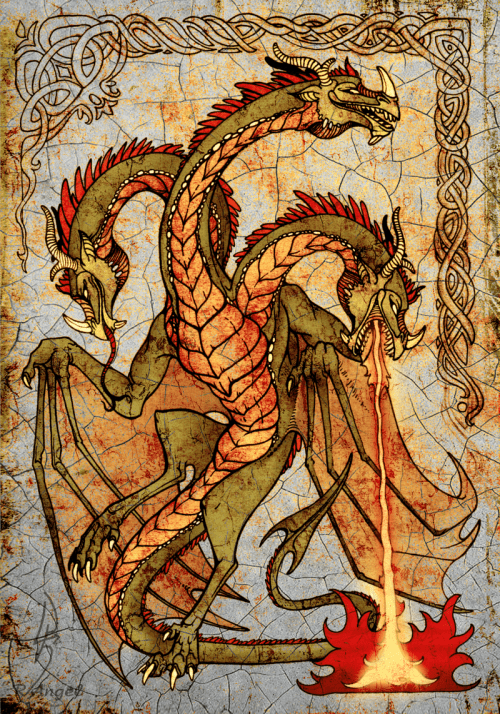 Above: The three-headed dragon of the Baltic legends
https://mythlok.com/azhdaya/
From the onset of the human civilization to this very day, we are continuously treating nature as a beast to be tamed and controlled but most of our efforts proved to be futile. Beyond any doubt, a time will eventually come when humanity will finally realize that nature should be regarded in a true sense of her universally accepted role – Mother Nature, and that it will be treated just like our own mothers – with love, respect and care.
Our ancestors have never exhibited such ignorance towards nature as well as arrogance towards animal world as we display it today with such ease and an utterly careless attitude. In spite of all their efforts, they were undoubtedly aware of their inability to fully control or conquer nature, weather, the rivers and the seas, and especially the mountains. Even during the daylight, the mountains – their thick forests, treacherous terrains, inaccessible cliffs, deadly abysses, and avalanches – presented a formidable challenge. At night, however, even the smallest cracking sound would paralyze humans with fear, while a sudden cold breeze would send shivers down their spines and scare them to death.
It is the very realization of such helpless human vulnerability that gave rise to the belief in supernatural beings and spirit entities of the mountains. Apparently, it is not that we couldn’t conquer them because of the immensity of these great rocks or the lethal powers of fierce mountain storms, but because of the mighty deities and evil spirits who prevented us from entering their world. As usual, it is more convenient to invent some powerful foe than to admit that we are powerless and insignificant little creatures at this vast natural playground. And so the mountains with their great powers became the magical entities that should be feared and respected.
IV
SHARA MOUNTAIN
Let’s take a closer look at this magnificent mountain featured in our folk song – the mighty Shara Mountain!
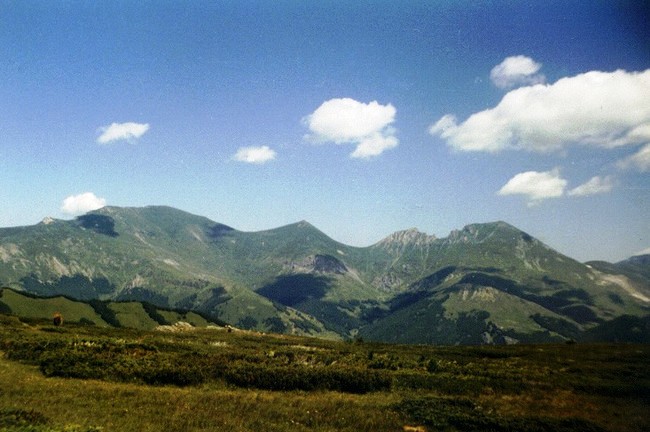
Our planet’s geographic features – such as mountains, rivers and lakes, straits and oceans, served throughout the human history as natural physical borders between different tribes, ethnic groups, and later kingdoms, empires and states. These same natural features were often used as central points around which tribes and states evolved and identified their land with them.
Shara Mountain is another such example of natural borders. It is located in the heart of the Helm region and it forms the border between Serbia and North Macedonia, with its southwestern section running along the eastern border of present day Albania. In the ancient times Shara mountain was considered to be the border between the Serbian and Byzantine lands, before the Serbian Emperor Dushan the Great (Цар Душан Силни) finally reclaimed most of the historic Serbian and Slavic lands from the declining Byzantine Empire in the XIV Century.
The point of interest here is the mountain’s name since there are several theories about its origin. Most of these theories involve names given to it by foreigners or sources from nations not native to these lands, and they are – quite curiously, not taking into account the languages of the autochthonous Slavic tribes who inhabited these lands for several millennia.
One of the most hilarious explanations floating around the internet, involves the language of one of the historically recent newcomers to these lands, although it is well documented that these nomadic tribes were brought to the Helm region as mercenaries from the Caucasus Mountains in the XI Century by the Byzantine general George Maniakes for his military raids and his eventual attempt to overthrow the Byzantine Emperor Constantine IX. Eventually, these foreign tribes managed to grow in numbers and, with the continuous backing by the unfriendly Western European powers, continue to create havoc among the Balkan nations to this day.
Without making any claims, it will suffice for the scope of this essay to note that the word shareno (шарено) in Slavic languages, such as in Serbian or Macedonian, denotes something colorful. For example, shara (шара) or sharka (шарка) – an archaic Serbian word for color or pattern, is still in use today to describe something vibrant or colorful – or a small decorative element.
This connection resonates with The Shara mountain – known for its extraordinary beauty and colorful natural environment, so it’s no surprise that it has been recognized by UNESCO as a World Heritage site due to its biodiversity and ecological significance.
Shara mountain’s peaks reach well beyond 2500 meters (8200+ feet) above the sea level and it features 70 lakes which are being called “mountain eyes”. Shara’s biodiversity includes more than 2000 floral species, 18 of which are endemic to this mountain and cannot be found anywhere else on the planet.
One of the plants – Natalie’s Ramonda (Serbian: Наталијина рамонда, Latin: Ramonda nathaliae), discovered in 1884 by botanists Sava Petrovic and Josif Pancic who named it after the Serbian Queen Natalia of Serbia (1859-1941), has a unique ability to revive itself even after being completely dehydrated. Due to this extraordinary ability it has become one of the national symbols of Serbia and of Serbian people’s struggle in the World War I in which they had barely avoided a total physical annihilation, and survived only after suffering unimaginable human losses and after their heroic victory.
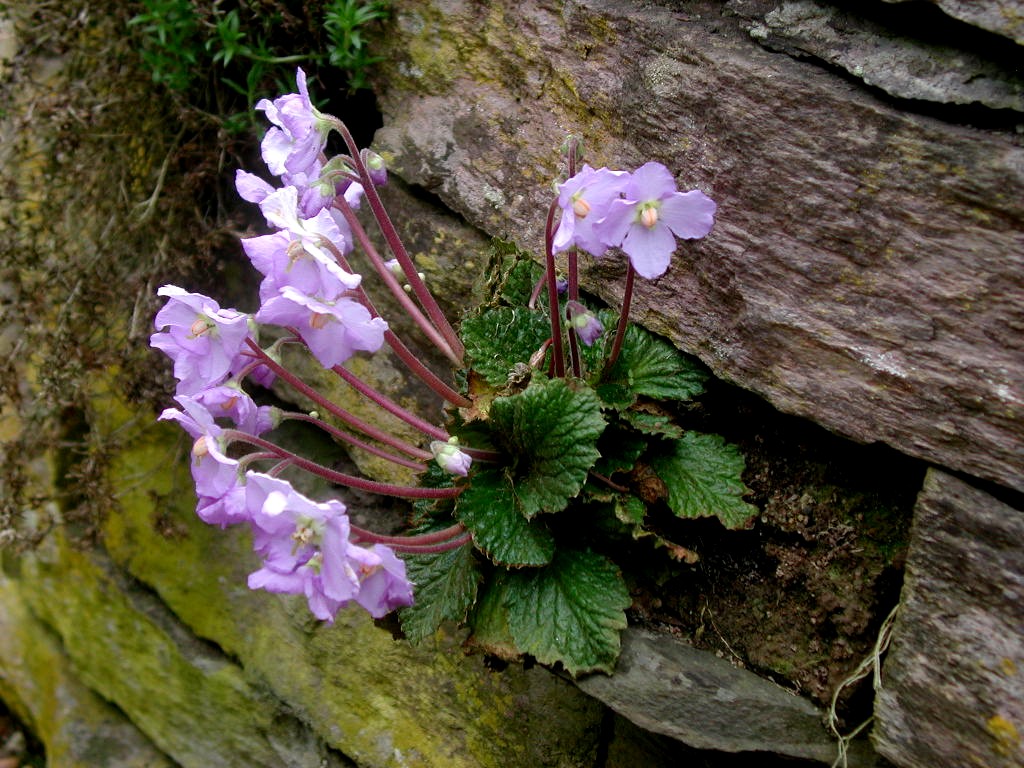 https://en.wikipedia.org/wiki/Ramonda_nathaliae
Shara mountain is one of Europe’s richest habitats with hundreds of animal species thriving in its forests. One of its specially designated Natural Reserve areas is home to less than 100 remaining specimens of the endangered species of Balkan lynx (Latin: Lynx lynx balcanicus) – Europe’s largest wild cat.
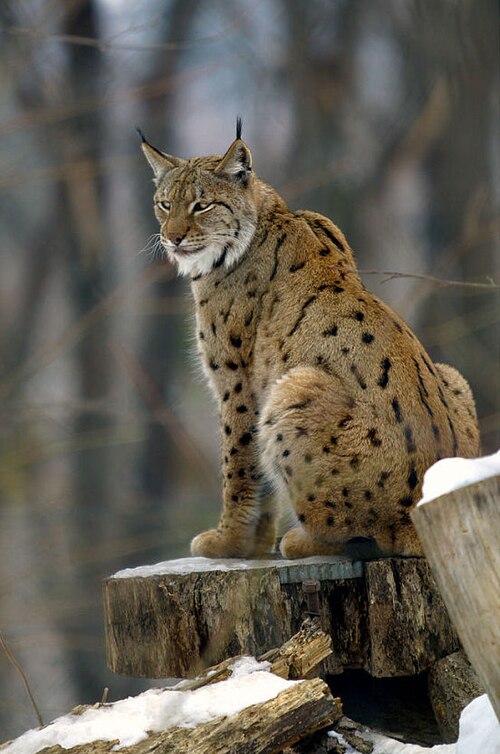 (source link)
Shara mountain also has its own breed of dogs. Recognized by the International Canine Federation as the “Yugoslavian Shepherd Dog – Sharplanina (Jugoslovenski ovčarski pas – Šarplaninac) the Sharr dog is a breed of livestock guardian type and it originates in the Shar Mountains range.
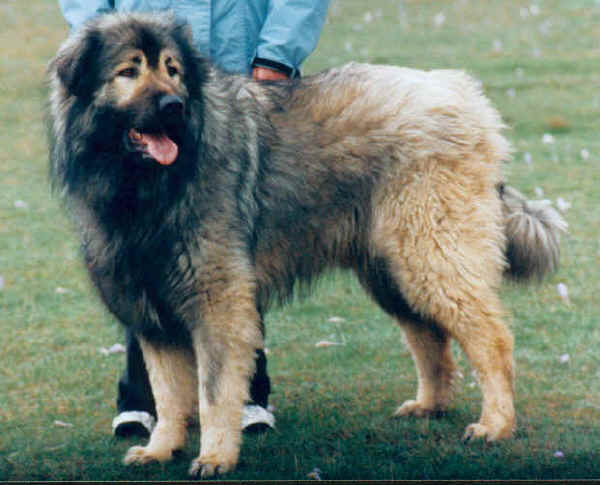 (source: https://en.wikipedia.org/wiki/File:Sardog.jpg)
V
“NAVALI SE SHAR PLANINA” FOLK SONG
This old traditional folk song revolves around the shepherd culture and traditions – just like the folk song “Tija maglo” which I’ve treated in a separate article (link here). The songs originate in different areas of the Helm region and this immediately becomes apparent with their specific musical styles and singing techniques. For example, “Tija maglo” is set over a freely flowing rubato tempo, while “Navali se Shar-planina” is based on a precisely defined rhythmic structure. Moreover, each song sets a completely different mood, with the later being grave and heavy, while the former carries an air of lightness and warmth.
Despite their differences, both songs feature the anthropomorphic symbolism, which is a hallmark in South Slavic oral tradition, and through which a natural object or phenomena acquires human qualities. In this case, the Shara mountain goes beyond the confines of a simple setting in which the narrative unfolds, to becomes a powerful human-like entity and a main protagonist.
Despite the pastoral setting and the song’s surface layer, its ultimate message and deeper meaning point to the universal theme of love and loss. Some readers might find the concluding verses to be insensitive, uncomfortable or particularly harsh, but this song is simply a testament to the Slavic people’s tendency to communicate openly and directly, without resorting to elaborate metaphors and figurative language.
There are numerous variations of the lyrics – from traditional ones sung in the archaic dialects, to the shorter versions with omitted concluding verses, and even the ones with mixed up content or considerable variations.
Following is an integral modern Serbian version:
НАВАЛИ СЕ ШАР-ПЛАНИНА
(Serbian version)
Навали се, навали се Шар планина
‘ајде и потхвати,
и потхвати три чобана.
Први чобан, први чобан њој се моли:
‘ајде пусти мене,
пусти мене, Шар планино.
Имам жену, имам жену што ме жали
‘ајде имам жену,
имам жену што ме жали.
Други чобан, други чобан њој се моли:
‘ајде пусти мене,
пусти мене, Шар планино.
Имам сестру, имам сестру што ме жали
‘ајде имам сестру,
имам сестру што ме жали.
Трећи чобан, трећи чобан њој се моли:
‘ајде пусти мене,
пусти мене, Шар планино.
Имам мајку, имам мајку што ме жали
‘ајде имам мајку,
имам мајку што ме жали.
Проговара, проговара Шар планина,
‘ајде проговара,
проговара Шар планина:
Жена жали, жена жали за годину,
‘ајде сестра жали,
сестра жали три године.
Мајка жали, мајка жали довека,
‘ајде мајка жали,
мајка жали довека.
This is the Macedonian version, as sung by the shepherds on the Macedonian side of the Shara mountain:
СЕ НАВАЛИ ШАР ПЛАНИНА
(Macedonian version)
Се навали, се навали Шар Планина,
ајде се навали,
се навали, Шар Планина.
Ми потисна, ми потфати три овчари,
ајде три овчара,
три овчара, три чобана.
Први овчар, први овчар ѝ се моли,
ајде пушти мене,
ај пушти ме, Шар Планино.
Имам жена, имам жена што ме жали,
ајде имам жена,
имам жена, ќе ме жали.
Втори овчар, втори овчар ѝ се моли,
ајде пушти мене,
пушти мене, Шар Планино.
Имам сестра, имам сестра, ќе ме жали,
ајде имам сестра,
имам сестра, ќе ме жали.
Трети овчар, трети овчар ѝ се моли,
ајде пушти мене,
пушти мене, Шар Планино.
Имам мајка, имам мајка, ќе ме жали,
ајде имам мајка,
имам мајка ќе ме жали.
Жена жали, жена жали шест недели,
ајде сестра жали,
сестра жали до година,
Мајка жали, мајка жали дур’ довека,
ајде мајка жали,
мајка жали дури до гроба.
For comparison, here’s another shorter version – recorded in 1946 as sung by a local singer from the Serbian province of Kosovo and Metohija in an archaic local Serbian dialect:
НАВАЛИ СЕ ШАР ПЛАНИНА
(Short Serbian version)
Пропаде ми Шар Планина,
Притисна ми три офчара,
Три офчара, три чобана.
Први офчар гу се моли:
„Пушти мене, Шар Планино,
Имам жену што ме жали!“
Други офчар гу се моли:
„Пушти мене, Шар Планино,
Имам сестру што ме жали!“
Трећи офчар гу се моли:
„Пушти мене, Шар Планино,
Имам мајку што ме жали!“
Проговара Шар Планина:
„Жена жали за годину,
Сестра жали три године,
Мајка жали дур до века!“
Finally, this is the English translation:
SHARA MOUNTAIN LEANED OVER
It leaned over, the Shara mountain leaned over
and it trapped,
it trapped three shepherds.
The first shepherd, the first shepherd prays to her:
Come on, let me go,
Let me go, Shara mountain.
I have a wife, I have a wife who grieves for me,
Come on, I have a wife,
I have a wife who grieves for me.
The second shepherd, the second shepherd prays to her:
Come on, let me go,
Let me go, Shara mountain.
I have a sister, I have a sister who grieves for me,
Come on, I have a sister,
I have a sister who grieves for me.
The third shepherd, the third shepherd prays to her:
Come on, let me go,
Let me go, Shara mountain.
I have a mother, I have a mother who grieves for me,
Come on, I have a mother,
I have a mother who grieves me.
It speaks, the Shara mountain speaks,
Oh, it speaks,
the Shara mountain speaks:
The wife grieves, a wife grieves for a year,
Oh, sister grieves,
sister grieves for three years.
Mother grieves, mother grieves forever,
Oh, mother grieves,
mother grieves forever.
The song tells the poignant story of three shepherds trapped by the Shara Mountain, each pleading for their lives based on who is left behind, waiting for them to return. Ultimately, the story reveals the profound truth: that mother’s love is unconditional, and the loss of a child is an enduring wound that will never be truly healed.
The English translation above is based on the Serbian version, but there are some interesting discrepancies between different sources. For example:
– in the Serbian version wife grieves for one year and sister grieves for three years.
– while in the Macedonian version wife grieves for six weeks and sister grieves for one year.
To be fair, I also found some Serbian recordings with the “wife & six weeks” variation, suggesting it isn’t specific to Macedonian versions.
Going back to the 1960s and 1970s, many contemporary recordings and performances omit the concluding verses, focusing instead solely on the shepherds’ prayers to the mountain, without mentioning their loved ones’ grief.
Here’s an examples for these short versions:
Navali se Shar Planina by Bora Spuzic Kvaka (recorded in 1975 for RTB – Belgrade, Serbia)
https://www.youtube.com/watch?v=0cCRNQq7g8w
A politically correct explanation for these omissions would probably blame them on the restrictions of the broadcasting industry – such as keeping the song within the radio-friendly duration requirements. However, these omissions were more likely a form of soft censorship – an effort to keep the song acceptable for public performances, as some listeners would have felt offended by its somewhat harsh and unpleasant statements about the limits of commitments, relationships and love.
A modern a cappella rendition, inspired by the traditional vocal techniques, by the Serbian folk music duo The Teofilovic Brothers:
https://www.youtube.com/watch?v=d6_vt_gUaaU
Another live rendition by the Teofilovic Brothers and Miroslav Tadic, Serbian guitarist:
https://www.youtube.com/watch?v=JEY3bGgN9v8
This is a short rendition played on the authentic folk instruments, performed by Aleksa Radonjic:
https://www.youtube.com/watch?v=L8Xyl57UT9A
VI
MUSICAL CONTEXT
„Navali se Shar-planina“ shares a very similar melodic motif with another folk song „Gusta mi magla padnala“ which starts with a nearly identical 4-bar sequence. This similarity should not be a surprise as both songs originate in the same geographic area around the Shara Mountain (Шар-планина) and they belong to the folk music tradition of „Изворне песме“ (traditional roots music).
Both of these melodies could possibly owe their existence to another, even older source song. I suppose that the melodic line in „Gusta mi magla padnala“ is older – as it is shorter and simpler, while the extended tail section in „Navali se Shar-planina“ seems to be a later development that was simply added in order to accommodate the longer lyrical content. These songs are perfect example of shared melodic motives.
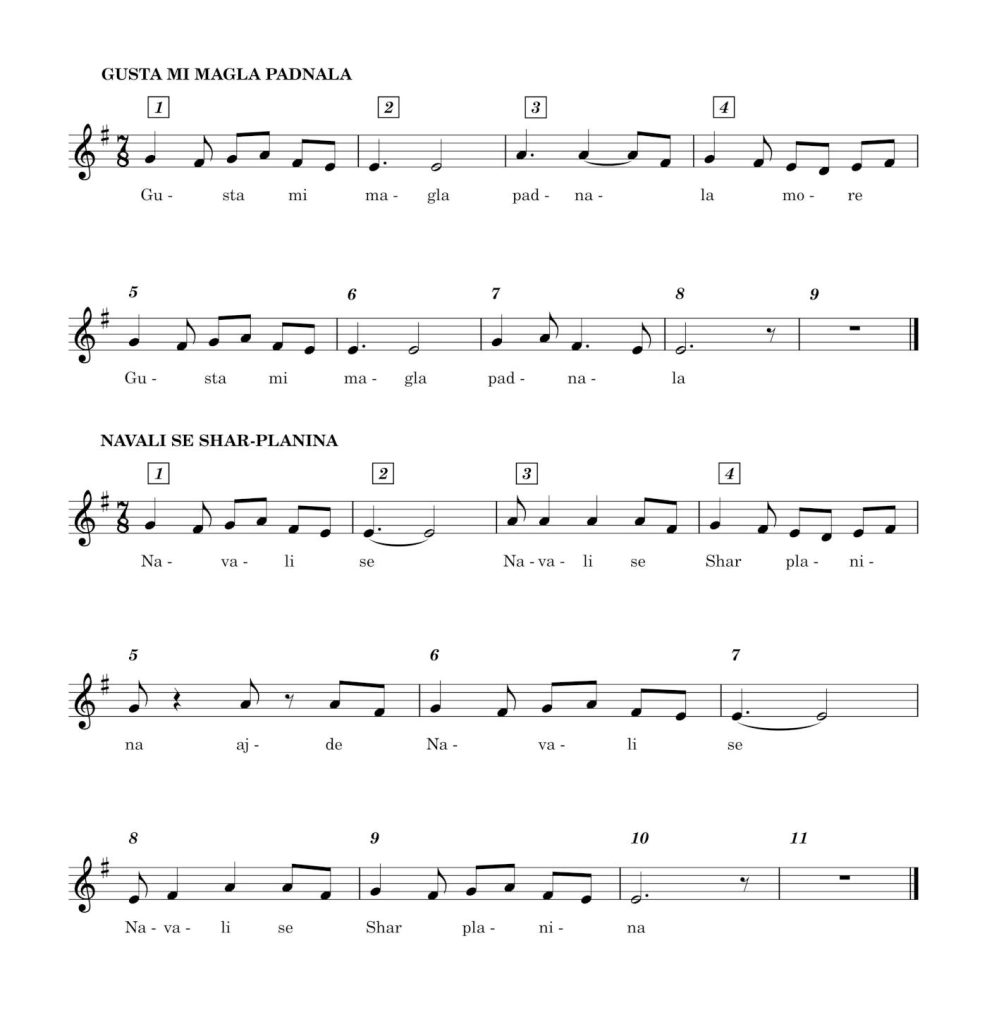
The melody is set to a 7/8 odd meter with the actual metric subdivision of 3 + 4 (or 3 + 2+2) and the song evolves through the alternating instrumental and vocal sections.
In traditional performances on authentic folk instruments, there is little emphasis on dynamics, which is then experienced mainly through the gradual buildup of lyrical intensity. On the other hand, in contemporary settings with modern instruments, such simple structure and repetitive melody can be dramatically enriched with appropriate performing and arranging techniques. This is what I aimed for in my solo piano arrangement, in which the increasing lyrical intensity is being manifested by embellishing each consecutive melodic cycle with additional features. The embellishing begins by doubling the melody with a unison line in the upper octave, then by introducing a supporting melody in the left hand, and finally by constructing a fully developed accompaniment.
„Navali se Shar-planina“ by Koshanin, from the album „Under The Sacred Tree“ released in 2017:
link: https://www.youtube.com/watch?v=wJzDN6MbW-g
The alternate version from the „Under The Sacred Tree [432Hz Edition]“ album released in 2018:
The sheet music for my piano arrangement of „Navali se Shar planina“ is available as an individual sheet (PDF download here) or in the Songbook for the „Under The Sacred Tree‘ album (PDF download here).
Instead of using the vocal melody as the basis for creating the connecting instrumental sections – as is the case in traditional arrangements – I have introduced a new connecting theme that divides the song into four main sections. By enveloping each melodic section with this simple, ostinato-like theme, the melancholic tone is emphasized, with each section being anchored back into this underlying minimalist theme.
The first three main sections feature two iterations of the core melodic theme, followed by short turnarounds which repeat the final phrase over a modified descending chord progression. These turnarounds represent a new development within the song’s linear structure, particularly given my hypothesis that the simple melody in ‘Gusta mi magla padnala’ later evolved in ‘Navali se Shar-planina’, and they become essential for transforming it into a compelling piano instrumental. The fourth main section then presents two further iterations of the melody, linked by the new connecting theme, leading to the concluding statement that utilizes an expanded harmonic palette and a slightly altered harmonic structure.
In piano music, a common function of parts played by the left hand is to accompany the melody, provide a harmonic support and to outline the rhythmic feel. In this arrangement, the rhythmic accompaniment in the first two sections deviates from that rule. The rhythm is not clearly stated since it does not strictly follow the 3+2+2 metric subdivision of the 7/8 meter. The rhythmic patterns in the left hand keep avoiding the defining downbeats of the 7/8 meter and accent the upbeats instead. The natural feel of the 7/8 meter becomes concealed and the function of outlining the rhythm is transferred to the right hand, where it is revealed through the phrasing of the melody. At first, this dancing around downbeats poses a challenge to the unfamiliar listener in recognizing and feeling the 7/8 meter, but as the song progresses, the steady rhythmic feel becomes fully established in the third section.
The final, fully harmonized invocation of the melody points to the closing verse which reveals the song’s ultimate message:
Mother grieves, mother grieves forever,
Oh, mother grieves,
mother grieves forever.
– – – – – – –
I dedicate this piano arrangement to all Mothers in the world and I hope that it brings some consolation to anyone who had experienced the loss of a loved one.
* * * * * * * * * * * * * * * * * * * * * * * *
If you enjoyed this essay please show your support and Subscribe to my YouTube Channel, follow my FaceBook Page or visit my Online Store for music downloads, CDs albums, sheet music and more. Thank you!
Copyright 2026 Koshanin. All rights reserved. Any copying, reproduction, or use, in part or full, without prior consent of the author is prohibited.