AN ELECTRONIC MUSIC HOMAGE
TO THE ANDEAN MUSIC AND A DYING GLACIER
Sometime around 1989, while taking a walk on the streets of Belgrade, Serbia, I arrived at one of the main city squares where a group of passers-by had gathered around a street performance act. As I walked toward this gathering, a warm sound of pan pipes filled the air, accompanied by the sounds of acoustic guitars and percussion. Expecting to see a group of local street buskers, I worked my way through the crowd that encircled them and soon realized that I was in for a real treat. There it was, right before my eyes, a four-piece group of Bolivian musicians in their colorful traditional outfits playing this beautiful music. Their presence, outfits and the delicate sounds of their music filled the entire square and gently bounced off the surrounding buildings, bringing great joy visible on everyone’s faces. Even the casual bystanders were delighted by this enchanting impromptu performance and, with each song, more cheerful faces joined the circle. I felt so grateful for this unique chance to listen to authentic Andean traditional music played by native musicians, which was otherwise rarely heard on the radio, TV, or LP records at best.
I managed to get hold of one of their cassette albums and, during the very first listen, I immediately recognized one of the songs they played that day – it was the album’s opening song “Funerales”, that got stuck in my head. The group’s name was “P’unchay” and the entire album, simply titled “Bolivia”, was very well-balanced and soothing, remaining in regular rotation on my cassette deck for quite a while.
“Funerales” – composed by Luis Rico, performed by Grupo P’unchay and released on their album “Bolivia”:
https://youtu.be/Y1p0MfX2Cfc
P’unchay musicians:
- Eduardo Uyuly
- Florentino Huanaco
- Cosme Amador
- Alex Amador
- German Huarachi
Instruments:
- Cuerdas (string instruments): Guitarra, Charango, Ron Roco, Mandolina
- Vientos (wind instruments): Zampoñas, Quena Tarkas
- Percusion: Bombo, Tambor Chajchas
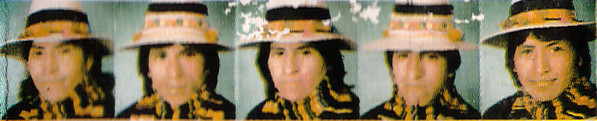
By the way, “p’unchay” – alternatively spelled as “punchaw” – means “day” in the Quechua language.
At around the same time, in 1989, a local group “Pachamama” was formed in Belgrade. The group consisted of local, classically trained musicians and was performing traditional music from the Andes. This excellent group performed on authentic South American instruments while dressed in colorful traditional outfits. They performed live until the late 2000s, and while I am not sure if they are still active, their albums have become highly prized collectors’ items, as they are very hard to find.
“Phuru Runas” – Pachamama (live)
https://youtu.be/AHUBgOpEyq0
“Phuru Runas” – an instrumental composition by the Bolivian artist Ramiro De La Zerda, performed by the Pachamama ensemble and recorded live in 1995 at a concert at the Novi Sad Synagogue, in the city of Novi Sad, Serbia. This was their joint concert with another famous Serbian group “The Orthodox Celts” that plays Irish Folk and Celtic Rock music. The recording of this concert has been subsequently released in 1996 as a live album “Orthodox Celts / Pachamama – Muzičke paralele” (“Orthodox Celts / Pachamama – Musical Parallels”)
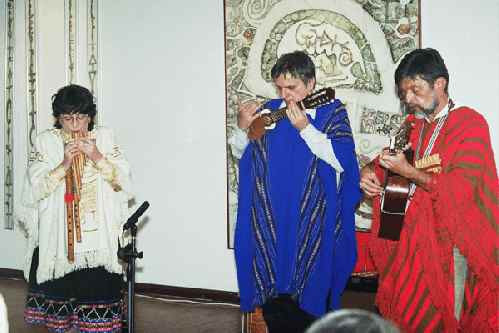 Pachamama ensemble
Pachamama ensemble biography:
Source (inactive): http://pachamama.fortunecity.com/
Adapted and translated to English by Koshanin
The Pachamama ensemble was formed in 1989 in Belgrade, Serbia (Yugoslavia) by local classically trained musicians. Music performed by the Pachamama ensemble consists of traditional South American music from countries around the Andes mountain range: Argentina, Bolivia, Ecuador and Peru. At the time, they were the only group in Yugoslavia that performed exclusively South American music. The group strove to stay true to the authentic arrangements and stylistically clean interpretations and their repertoire included traditional songs as well as original music composed by the group members and inspired by the South American traditional rhythms. The group performed on authentic South American instruments and sang in Spanish and Quechua language (the official language of the ancient Inca Empire). Pachamama released six albums and some of their music appeared on several compilation albums featuring South American music.
It was sometime in 1996 that I got a new keyboard – an Alesis QS6 synthesizer – and, like with any new musical instrument, I spent countless hours playing, testing and discovering all of the sounds and capabilities of this new musical gadget.
One day, I got so excited when I accidentally stumbled across the P’unchay cassette, stacked in a dusty box with dozens of other old tapes. It immediately found itself rolling in my cassette deck. While listening to it, I got an idea to recreate one of the songs with this new synth. The goal was to explore the possibilities and limits of this new synthesizer, attempt to recreate a natural sound of acoustic instruments with an electronic instrument, and get as close as possible to the sound of the original recording.
This idea eventually turned into a kind of case study in MIDI sequencing, with an emphasis on the sequencing of plucked string instruments.
In contrast to some of my other MIDI production works – especially the Electronica-style music projects that involved advanced MIDI programming techniques – this project turned out to be a straightforward performance, where each instrument sound was played on a synthesizer and recorded in real-time to a MIDI sequencer, followed by minimal editing and fine tuning of the recorded MIDI tracks.
For this project I used the Alesis QS6 synthesizer and Roland MC-50 Micro Composer sequencer.
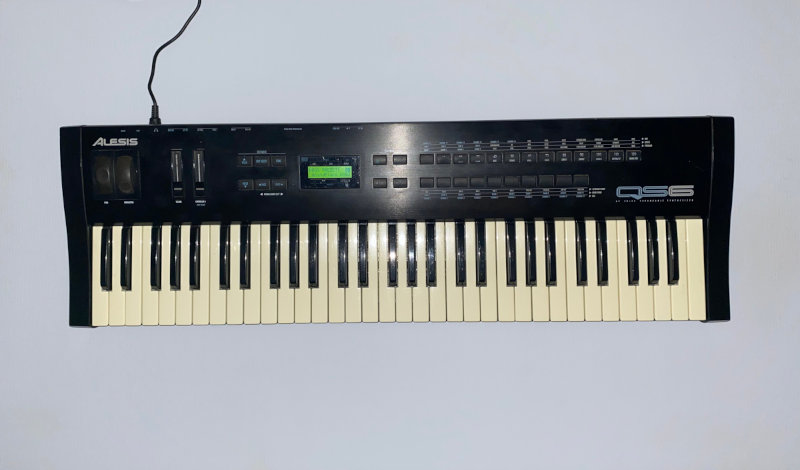 Alesis QS6 Synthesizer
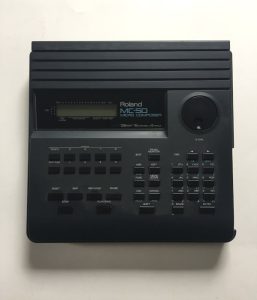 Roland MC-50 Micro Composer
The year was 1996 – a “prehistoric” era before the widespread use of laptop computers – when “Windows 95” reigned over the computing market. Consequently, any serious attempt at audio recording on a regular consumer-grade desktop computer faced substantial obstacles and challenges. At the time, I could only record the entire song directly into the computer as a single stereo track. I had to wait for a few years before finally being able to record the song properly, once digital recording equipment and software became more advanced.
By the way, at the time of this writing – all of the equipment used for this project is now considered vintage audio equipment, and honestly – I don’t think that’s funny!
Years later, when I stumbled upon my recording of “Funerales” in my audio archives, I decided to create an accompanying video using photos from one of my mountain hikes in Colorado. This was sometime in the summer of 2007, and the hike was to Saint Mary’s Glacier near the town of Alice in the Arapaho National Forest in the Rocky Mountains of Colorado.
This former glacier has been re-categorized as a “semi-permanent snowfield”, as it does not move and is stationery. It is actually a remnant of an ancient glacier that is unfortunately rapidly shrinking, and it most likely won’t survive the XXI century. It starts at an elevation of approximately 10,300 feet (~3,140 meters) and supplies a small glacial lake with crystal-clear fresh water. Reaching the base of the glacier from the nearest paved road requires a moderate 30-40 minute hike through the woods. This idyllic, captivating landscape leaves you speechless as you soak in every moment, while a feeling of sadness sets in as you realize that this beauty will quietly disappear in the not-too-distant future.
I took these photos of the Saint Mary’s Glacier and Lake in the summer of 2007:
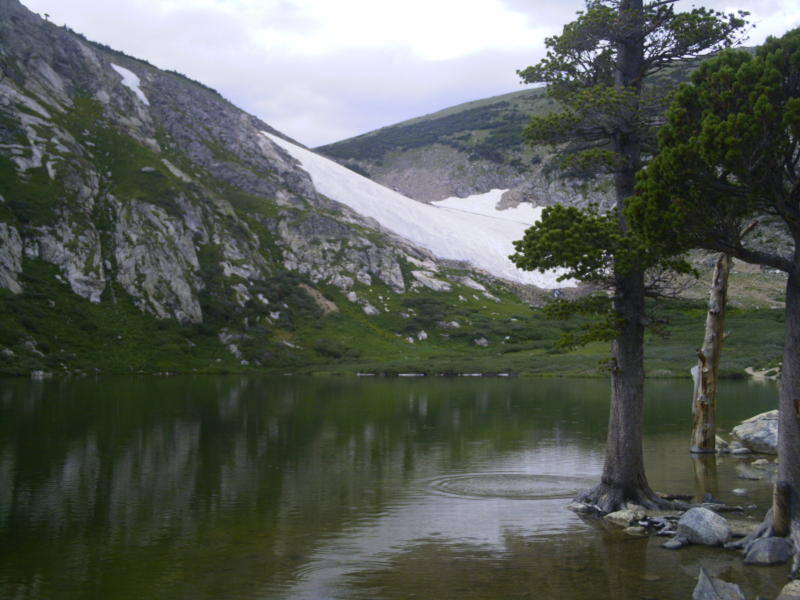 View of the Saint Mary’s Glacier from the shore of the Saint Mary’s Lake which it supplies with fresh water
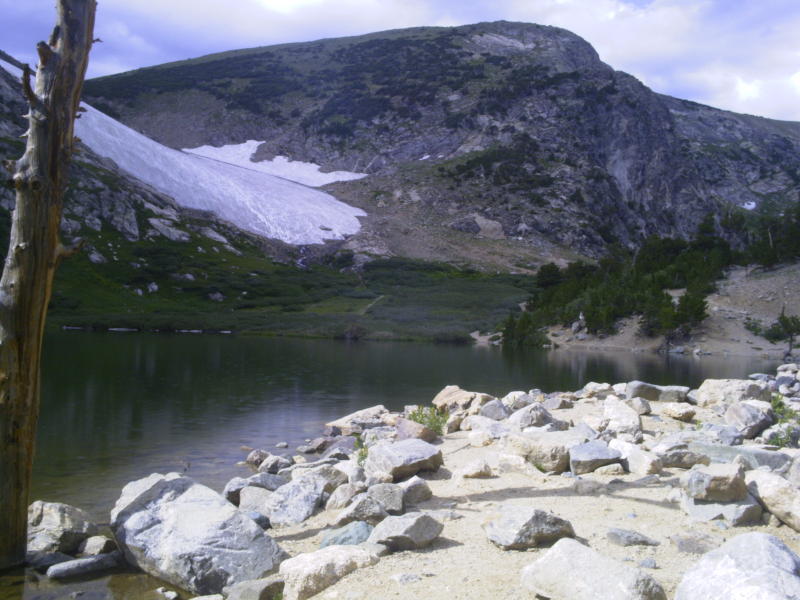 The rocky shores of the lake with a view of the Saint Mary’s Glacier
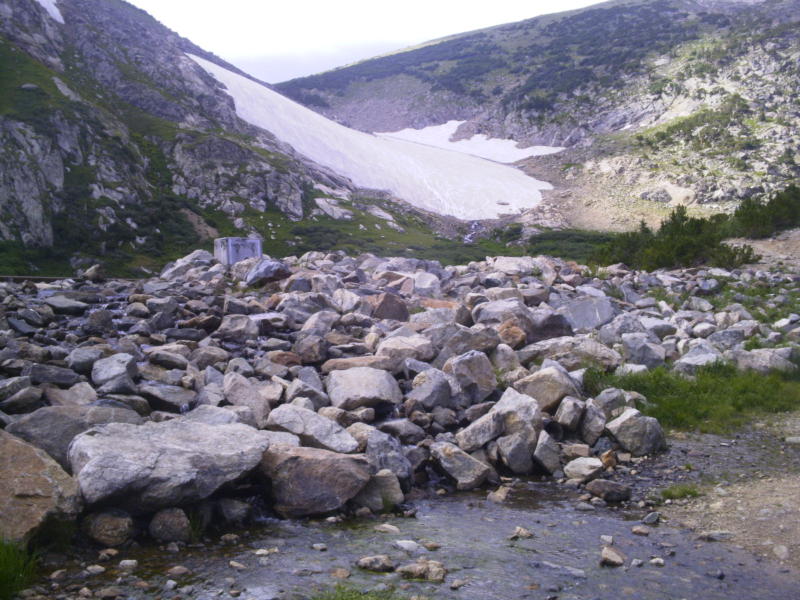 Rocks deposits separating the base of Saint Mary’s Glacier from the lake
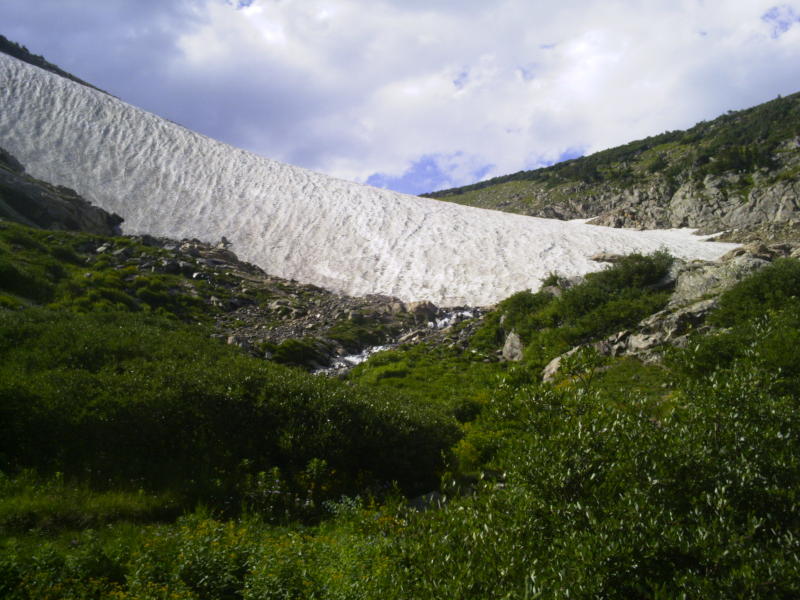 View of the Saint Mary’s Glacier with the water stream running from its bottom to the lake
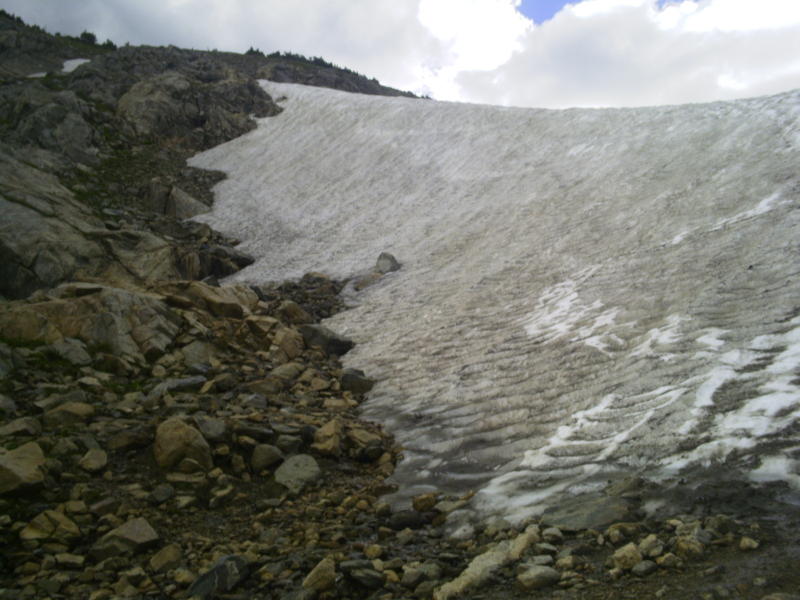 View of the Saint Mary’s Glacier from its base
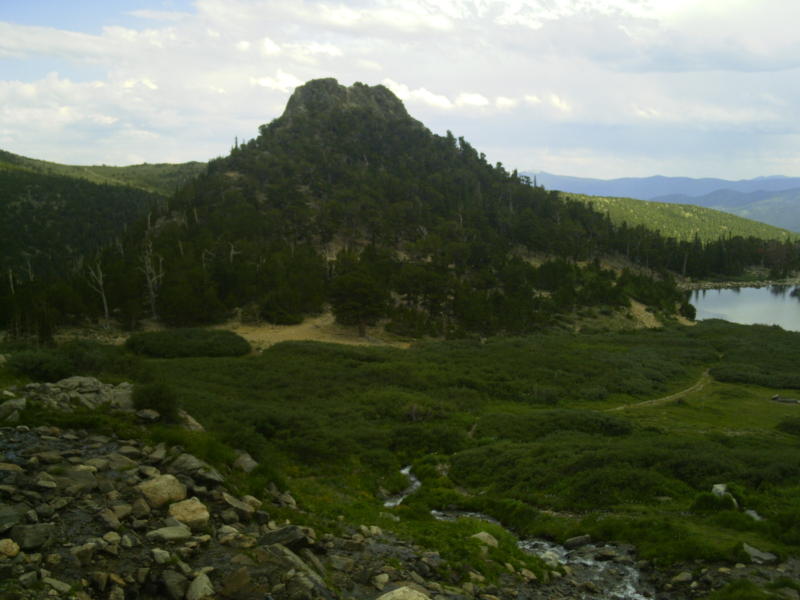 View of the surrounding hills from the bottom of Saint Mary’s Glacier
Given the mood of the song and its perfectly fitting title, “Funerales” (funerals in English), I felt it would be a suitable musical accompaniment to pay tribute to such a touching, fragile work of Mother Nature.
Funerales – arranged as it appears on the album Bolivia by P’unchay
Performed, recorded and recreated on Alesis QS6 synthesizer by Koshanin:
https://www.youtube.com/watch?v=dxgqPmIJklI
If you already listened to the original recording by the group P’unchay (posted above), I hope you agree with me that my recreation of this gem comes pretty close to it, considering the limitations of MIDI equipment and the recording technology available at the time (in 1996).
For musicians and the technically inclined ones, here’s some more details on how I created this recording:
Step 1
Sound Setup
The instrumentation on P’unchay’s original recording consists of:
- 3 Acoustic Guitar instruments
- 2 Flute-type instruments
- 1 Bass Drum
- 1 Clave-type percussion – which is most likely sound of a bass drum rim being hit with a drum stick
I browsed through the QS6’s sound banks until I found the closest-sounding instruments. I then tweaked them further to achieve the best match. Here are the presets I selected as starting points:
- for Acoustic Guitars and Mandolin: Program #33 – ClassiclAx from the User Program Bank
- for Flutes: Program #72 – PanPeople from the Preset 1 Program Bank
- and one of the Drum Kit programs with the similar sounding Bass Drum and Clave percussion sounds
A total of 8 separate MIDI tracks were recorded:
- 2 Flute tracks
- 2 Acoustic Guitar tracks
- 2 Mandolin tracks (the reason for two separate tracks explained below!)
- 1 Bass Drum track
- 1 Clave track
Step 2
MIDI recording: synthesizer → sequencer
I played each instrument part on the Alesis QS6 synthesizer and recorded it to the Roland MC-50 Micro Composer sequencer, using a separate MIDI track for each part.
For those not familiar with MIDI recording:
The advantage of recording MIDI tracks is that the data is saved in the sequencer (or a computer) as a MIDI-data file. Unlike an audio recording, MIDI file can be replayed by sending the recorded data from the sequencer to a connected synthesizer. This allows for each instrument part to be further edited individually.
The only instrument in the original recording that was played continuously throughout the entire song is the arpeggiated guitar accompaniment, which served as an obvious starting point – a kind of a skeleton for the whole piece. It was recorded first, providing a foundation for all other instruments that were subsequently overdubbed, one by one.
Overdubbing of the tracks proceeded with the two percussion tracks on top of which the two pan pipes parts were added. Only then I approached the mandolin accompaniment as I felt that all the tracks created to that point would provide a solid foundation for creating the most demanding element – a very distinctive mandolin playing technique.
While the parts played on percussion instruments and pan pipes were easy to play on a synth – partly due to their simple arrangements – the real challenge was recreating the parts performed on the mandolin. This difficulty arises from the specific manner in which the mandolin was played, making it quite challenging to mimic and reproduce on a keyboard.
One of the recording tricks I utilized in this project was to create duplicate tracks. In order to create a believable, good sounding mandolin track I had to play and record the same part twice. Because of the natural variations in playing of each take, they blended very well when played simultaneously, and the resulting two-part track sounded very full. Consequently – a convincing effect of a Rasgueado strumming technique, played on a single mandolin, was achieved.
To achieve an even fuller and wider sound, the MIDI Channel Pan settings of the two tracks were adjusted, placing one slightly to the right and the other slightly to the left in the overall mix, thereby creating a pseudo stereo effect.
Step 3
MIDI playback and audio recording: sequencer → synthesizer → computer
After all the instruments were recorded and the entire MIDI arrangement completed, I then proceeded to play the song in real-time and record the audio output from the Alesis QS6 synth into the recording software on my desktop computer.
No additional effects were added to the final audio track since my computer at the time could not handle more than a single dry track. Only the slightly adjusted default effects that came with each sound patch (mainly reverbs and delays) were recorded simultaneously with the instrument sounds.
In fact, any tweaking or fine-tuning of the tracks – such as panning, volume adjustments, effects levels – had to be done in MIDI before the whole song was recorded into the computer. Attempt to successfully play back more than one track on my PC felt like winning a lottery jackpot, as it would often crash the entire system.
As I am writing this, I can recall many headache-inducing obstacles involved in this ancient recording setup such as Windows 95 OS inexplicably freezing out of the blue, recording software suddenly crashing in the middle of some delicate editing, or getting stuck with the famous hourglass wait cursor working on some task seemingly forever. Usually such disasters would end with losing hours or even days worth of work. Talking about starting over from ground zero…
Not event o mention that the recording software I used at the time was based on a destructive audio editing, which means that any changes applied to a recorded audio track were permanent and could not be easily undone – in contrast to the later introduced non-destructive audio editing capabilities, allowing adjustments without permanently altering the original audio files.
Those were the days, my friends …
As for audio production, things slowly improved with Windows 98 and Windows 2000, but it wasn’t until the release of Windows XP that a stable and reliable recording setup became possible. While Macs have always been superior to Windows for audio and video production, I can proudly say that I have been free of both operating systems for a long time and I highly recommend Linux distributions for any computing needs.
* * * * * * * * *
* * * * * *
* * *
I would also like to use my recording of the song “Funerales”
to pay my respect to my late friend, fellow musician
and multi-instrumentalist
Gerardo Calderon
who passed away in January of 2024 at his hometown in Mexico.
Kind, giving, talented and passionate – a true artist!
Adiós, amigo! Rest in peace!
https://www.youtube.com/watch?v=1sKPTqKYo7Y
Gerardo Calderón, a composer, teaching artist, producer, and multi-instrumentalist, was born into the vibrant world of music, dance, and culture in Mexico City where he studied classical guitar at the Escuela Superior de Musica. As the musical director of Grupo Condor and co-founder of Nuestro Canto with Nelda Reyes, he has deeply explored traditional Mexican music, Latin American folk, and Pre-Colombian sounds. With over 25 years of experience, Gerardo has dedicated himself to nurturing the northwest community through teaching and performing. His commitment extends to playing therapeutic music in elder care facilities, nursing homes, recovery centers, and for youth at risk and mental health facilities, bringing moments of joy and unique comfort. Beyond his roles in performance, education, and research, Gerardo also specialized in creating custom musical instruments. His craftsmanship extended to a diverse array of items such as pan flutes, rain-sticks, water drums, turtle boxes, cajon Peruano, and bombos (bass drums).
You can listen to some of Gerardo’s music here:
https://www.youtube.com/@gerardocgmusica8388/releases
* * * * * * * * * * * * * * * * * * * * * * * *
If you enjoyed this essay please show your support and Subscribe to my YouTube Channel, follow my FaceBook Page or visit my Online Store for music downloads, CDs albums, sheet music and more. Thank you!
Copyright 2026 Koshanin. All rights reserved. Any copying, reproduction, or use, in part or full, without prior consent of the author is prohibited.